Creativity doesn’t move in straight lines. In this reflection, I share why circles sit at the heart of my practice — as both decorative forms and deeper structures — and how a circular way of making invites us to slow down, notice, and return to creativity with care.
Returning to the Circle
A reflection on making, noticing, and the creative process
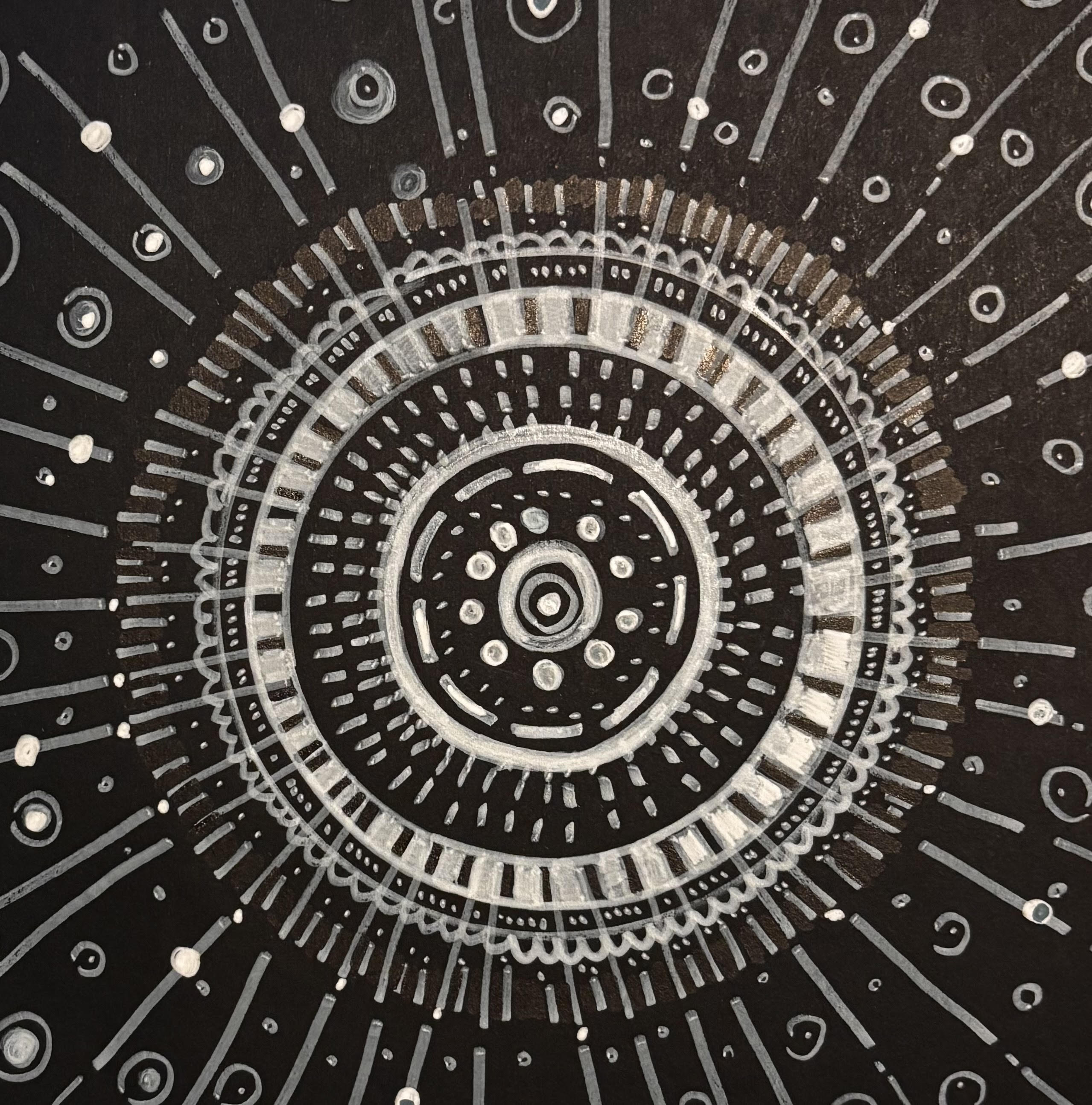
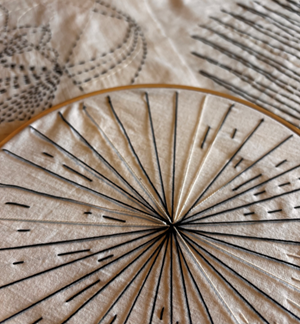
The circles in my work are often noticed first as decorative elements. They are also stitched forms, repeated shapes and gentle motifs that bring a sense of rhythm, cohesion and structure to a piece.
Over time, circles have become a quiet structure within my practice. They often feature in a meriad of ways and I have come to realise that they must hold how I understand creativity, awareness, and change. This is my visual langue that I am unable to express with words.
Straight lines often do appear in my work, in stitches, and with structure and composition, but I don’t approach creativity as a straight line.
I’m not interested in moving neatly from start to finish. That kind of linear structure is familiar in education and it serves a purpose, but it doesn’t reflect how I develop ideas.
Working within a circle, there is no “right” place to start, no top or bottom, and no part of the process that matters more than another. Everything belongs.
There is no final destination and I don’t move on from one part of the process to another.
Having recently studies theroreticl perspectives, I can see that this way of working is deeply informed by Gestalt theory. Fritz and Laura Perls described human experience as a continuous cycle of awareness, contact, and withdrawal. They believed growth happens not through forcing change, but through becoming more aware of what is present. Laura Perls spoke of organismic self-regulation and the idea that when we are able to notice ourselves honestly, we naturally move toward what we need.
In Gestalt terms, change arises through awareness.
That cycle lives in the way I work with textiles, noticing the feel of the fabric and its texture, choosing thread, stitching, pause and reflecting
and when something changes and shifts, I return.
The circle also reflects field theory and the understanding that we are always shaped by our wider context: our histories, environments, relationships, and cultural experiences. Nothing happens in isolation. Each piece of making sits within a larger field, even when we are working quietly on our own.
My training in the therapeutic arts reinforced this embodied understanding of process. Violet Oaklander’s work with expressive arts emphasises creativity as a way of meeting inner experience, not analysing it. She understood art materials as bridges between inner and outer worlds, allowing feelings and meanings to emerge safely through making.
Joseph Zinker also wrote about creativity in therapy as a form of experimentation: small, embodied acts that allow something new to emerge. His work highlights how making can support transformation when it remains playful, responsive, and rooted in lived experience.
These ideas shape how I currently see much of the textiles work that I create that isn't led by a theme.
Artistically, I have a wide range of different artists and designers I admire. I am often drawn to practitioners who work with repetition, rhythm, and return and perhaps my training in textiles design has a relevance here. Sonia Delaunay’s use of circular forms and colour relationships explored movement and harmony through abstraction. Her work wasn’t about decoration alone, it was about how colour and form create energy and connection.
The Bauhaus weavers, particularly Anni Albers, approached textiles as both material exploration and visual language. Their work embraced simplicity, structure, and experimentation, often returning to basic forms and repeated gestures to understand deeper relationships between surface, pattern, and meaning.
Across textile traditions, from quilting to mending to ritual cloth, circles appear again and again. Stitch itself is cyclical. The needle passes through cloth and returns. There is a rhythm. There is repetition and there is continuity.
For me there is something regulating and grounding about this process.
My background as an art teacher also sits quietly inside this work. Over the years, I’ve met countless adults who carry early beliefs such as I can’t draw or I’m not creative. These ideas often take root in childhood and remain unexamined. Linear models of learning, with their emphasis on outcomes and achievement, can reinforce that sense of failure. As adults we can change this view of ourselve
In Textiles for Wellbeing, circles become both literal and symbolic. Sometimes they appear as stitched forms. Sometimes they shape the structure of a workbook or workshop. Sometimes they are simply held as an idea.
They represent:
wholeness rather than fragmentation
return rather than progression
continuity rather than completion
equality rather than hierarchy
process rather than product
The three lenses I work with Connection, Identity, and Change, sit within this circular framework and they are not stages to complete. They are ways of noticing that can be revisited. You might explore Connection today, Identity next week, Change months later, and then return again, seeing something new each time.
This is not about self-improvement.
It’s about relationship.
Relationship with materials.
Relationship with your own responses.
Relationship with what emerges when you slow down and pay attention.
The circles remind me — and hopefully others — that creativity isn’t something you move through once.
It’s something you return to, gently, throughout your life.
If this way of working resonates, you’ll find it reflected in my workshops and workbooks, where I invite you to slow down, work with simple materials, and explore your own creative process at your own pace.